Transcranial focused ultrasound (tFUS) is one of the few neuromodulation approaches that is non-invasive, millimeter-precise, and able to reach deep brain nuclei directly. With 256/512-channel phased-array hardware, image guidance and an open software stack, TsingPAI builds a research-grade platform for write-in ultrasound brain-computer interfaces.
Hundreds of tiny ultrasound emitters fire with precisely computed delays. The waves safely pass through the skull and converge at a millimeter-scale point deep in the brain — like focusing sunlight into a single spot with a magnifying glass, except that what we converge is sound.
256/512 elements fire with precisely computed delays so the waves superpose in phase at the deep target, forming an ~2 mm high-energy focus whose energy falls off rapidly with distance.
Low-frequency ultrasound at 0.25–1 MHz balances skull penetration and focusing precision; individualized acoustic correction compensates for skull-induced refraction and attenuation.
The focused wave exerts minute mechanical stress on neuronal membranes, modulating mechanosensitive ion channels (Piezo, TRP, TREK and others); at commonly used research doses the dominant mechanism is non-thermal.
Effects subside after stimulation ends; frequency, duty cycle and intensity parameters enable excitatory or suppressive, repeatable and precise modulation.
| Dimension | tFUS — transcranial focused ultrasound | TMS — transcranial magnetic stimulation | DBS — deep brain stimulation |
|---|---|---|---|
| Invasiveness | Fully non-invasive | Non-invasive | Requires craniotomy and electrode implantation |
| Spatial resolution | Millimeter-scale (down to 2 mm) | Centimeter-scale | Millimeter-scale |
| Depth of action | Whole brain, deep nuclei | Mainly cortical | Deep targets reachable |
| Bidirectional modulation | Both excitation and suppression, parameter-tunable | Mostly cortical excitability modulation | Mostly continuous stimulation |
| Imaging compatibility | Naturally compatible with MRI / EEG / fUS | Electromagnetic interference | Artifacts and safety constraints |
Compiled from publicly available academic literature and clinical research reports, for research reference only; not a medical-use claim.
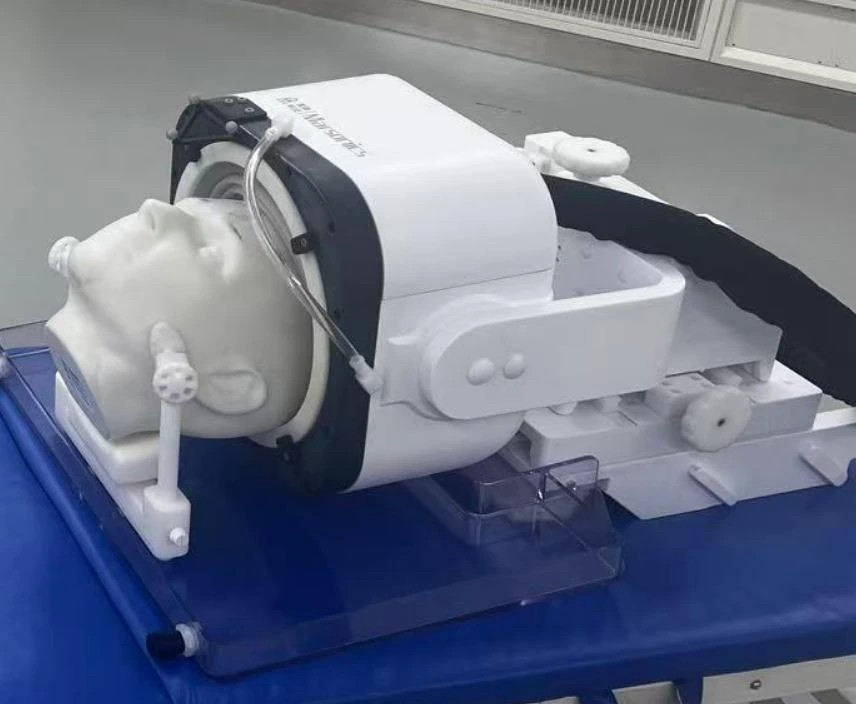 Helmet probe · binocular-vision registration · phased power ultrasound emitter · modulation workstation
Integrating a 256/512-element helmet-style hemispherical phased array, programmable power ultrasound emitter, binocular structured-light registration and acoustic-field simulation software into a complete "image-guided · deep-precise · non-invasive and reversible" workflow. MRI-compatible, and also deployable as a standalone research system outside the MRI suite.
| Parameter | tFUS-Neuro256 key specifications |
|---|---|
| Positioning | Integrated 256-channel system combining power probe and excitation source, for human cranial and animal neuromodulation, drug delivery, BBB opening, and LIFU / HIFU research uses |
| Frequency | 600 kHz center frequency, customizable 0.5–1 MHz, multi-frequency probes optional |
| Elements / probe | 256 / 512 channels; helmet-style hemispherical probe with 24–26 cm inner aperture matching typical human skull curvature |
| Channel control | Independent control of 256 / 512 channels with 5 ns per-channel delay precision; square-wave and other excitation waveforms |
| Output power | 2–5 W independent output per channel |
| Software | MATLAB / C# programming with graphical GUI; C/C++ SDK dynamic-link libraries (channel selection, frequency, delay, amplitude, duty cycle, PRF), supporting secondary development |
| Acoustic calibration | Precision acoustic navigation calibration and test support; optical dynamic visualization of phased-array fields; time-reversal calibration of focal position and shape |
| Optional extensions | Fused imaging / optical / EEG interfaces; raw phase-data export; vision-acoustics-skull co-registration equipment; open interfaces for image registration, acoustic computation and image segmentation |
Note: the above lists key specifications of the tFUS-Neuro256; for the 4-channel research version (TUS4A) and custom configurations, please contact sales for detailed documentation. Specifications are subject to the latest datasheets.
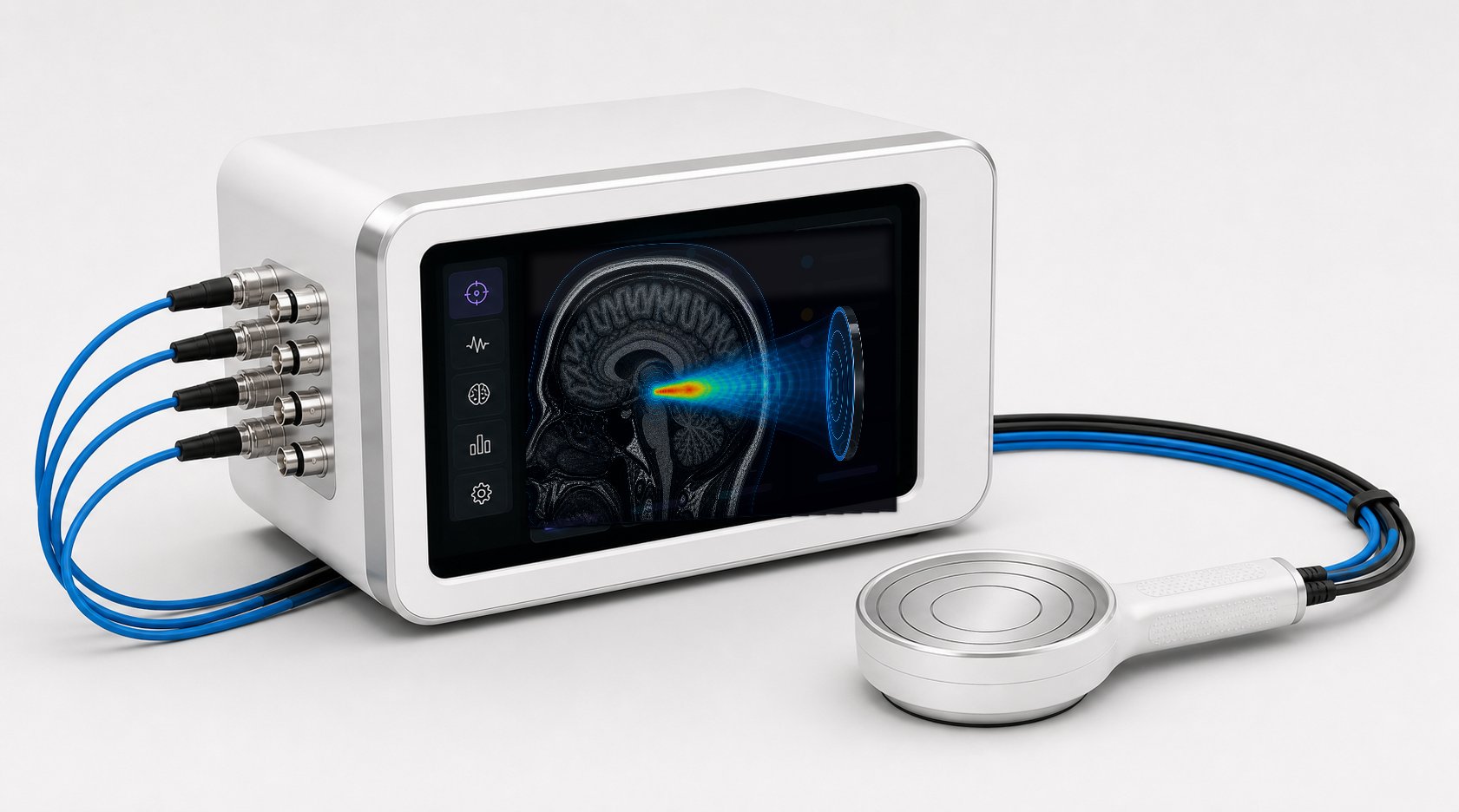 Desktop portable unit · binocular-vision navigation · 250K / 500K dual-frequency probes
For small-animal (rat, rabbit) and human-subject research scenarios, offering complete stimulation capability from single-target to multi-target network modulation. Standard binocular-vision navigation with a high-precision robotic arm keeps positioning hands-free; open MATLAB / Python SDKs let it drop quickly into brain-science and neuromodulation workflows.
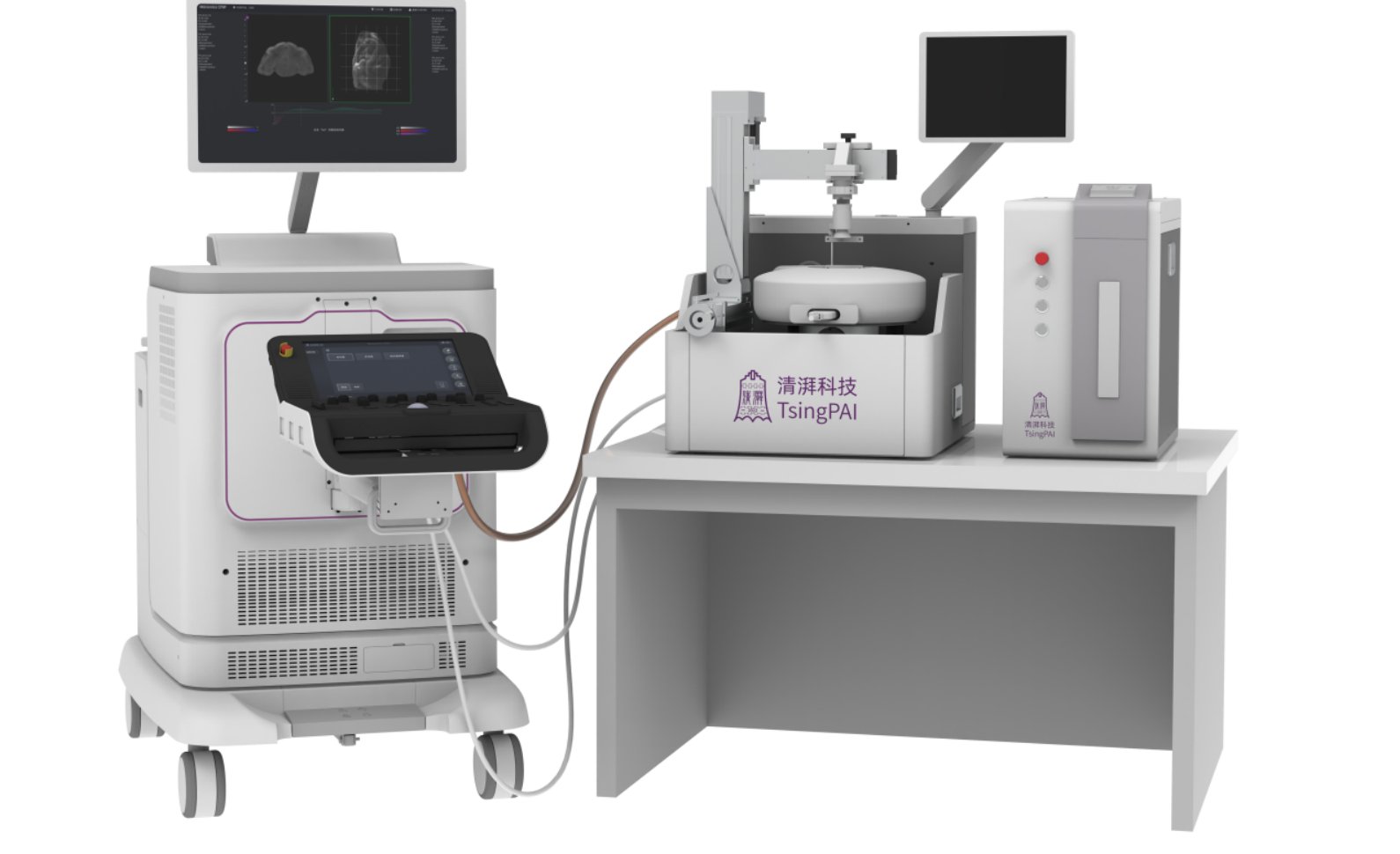 Imaging / modulation sync triggering · combined experiment platform
Photoacoustic / ultrasound imaging and focused-ultrasound modulation are co-integrated, correlating stimulation parameters with imaging responses through synchronized triggering. Ultrasound handles the "write-in", while fUS / photoacoustics / EEG handle the "read-out" — an engineering foundation for modulation-effect assessment and synchronized combined experiments.
The blood-brain barrier blocks roughly 98% of small-molecule drugs — and virtually all macromolecular drugs — from entering brain tissue, making it the central bottleneck of CNS drug development.
Low-intensity focused ultrasound combined with intravenously injected microbubble contrast agents induces stable cavitation of microbubbles in target vessels, mechanically stretching endothelial tight junctions and enabling local, transient and reversible blood-brain barrier opening (typically self-recovering within hours) — no craniotomy, repeatable.
TsingPAI advances preclinical validation, hospital / pharma collaboration and platform capability building around focused-ultrasound + microbubble reversible, targeted BBB opening: controlled and reversible opening has been verified with microbubble and dye methods, cavitation detection and closed-loop control have been implemented, small-animal validation is complete, and large-animal and clinical-study preparation is in progress. Related capabilities are confirmed per configuration and project, and do not constitute near-term regulatory-clearance or commercialization commitments.
250 kHz low-frequency probes cover the commonly used BBBO low-frequency window; 10 μs – 100 ms pulse parameters are widely adjustable and compatible with diverse microbubble protocols; multiple channels can drive multiple probes simultaneously to enlarge the opening region; vision navigation ensures target repeatability; open SDKs make it easy to link microbubble infusion pumps and imaging monitors to build closed-loop opening experiments.
Each direction below is supported by published human studies or frontier literature (compiled from publicly available academic sources, for research reference only; not medical-use claims).
Targeting the left dorsolateral prefrontal cortex (dlPFC); RCTs report significant symptom improvement maintained at follow-up.
Modulating pain-matrix nodes such as the anterior cingulate cortex (ACC) for rapid and durable analgesic effects.
Suppressive modulation of epileptogenic foci and deep thalamic nodes; multi-target capability supports epilepsy-network research.
Focused ultrasound has clinically approved precedents for tremor treatment (thermal-ablation route, a different technical route from low-intensity reversible modulation); theta-rhythm protocols open new network-level modulation paradigms.
Central-thalamus LIFU stimulation promotes behavioral-response recovery, non-invasively and at the bedside.
TPS cognitive improvement reported to last about three months; BBBO promotes pathological-protein clearance.
Targeting the nucleus accumbens (NAc) to reduce drug craving — an exploration of a "non-invasive DBS" pathway.
Promoting motor-function recovery and reducing infarct volume in ischemia models, while protecting blood-brain barrier integrity.
Double-blind RCTs show TPS attenuates core symptoms with effects maintained at 3 months.
Low-intensity rTUS significantly improves negative symptoms with objective increases in cortical excitability.
Exploration of cortico-striato-thalamic and amygdala-prefrontal circuit modulation.
Combined with EEG / fUS to build real-time closed-loop modulation systems, with ultrasound as the "write-in" channel.
Software version updates and hardware adjustments are provided where hardware permits, scheduled away from your critical experiment windows.
Engineers with both R&D and wet-lab backgrounds support platform setup, parameter tuning and pilot-experiment collaboration on site.
Every instrument gets a dedicated customer group with hardware, software and application-support staff for rapid response.
Researchers in relevant fields exchange on research directions, and user academic events are organized regularly.
From the portable 4-channel research version to the 512-channel flagship phased array, the TsingPAI team can propose a platform configuration matched to your project.